

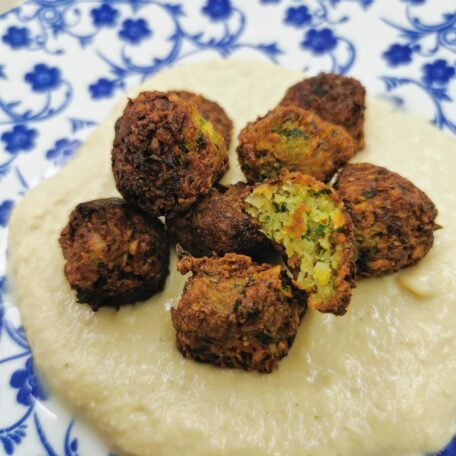
Dear God, how much I adore falafel but how difficult they can be to get right!
After more attempts that I can count, I finally got them perfectly crunchy, golden brown and mad delicious, WITHOUT deep frying too.
It took quite a bit of experimentation (read: failed attempts).
The hardest part was getting the balls to maintain their shape because in previous attempts, they would disintegrate the minute they touch the oil.
In traditional recipes, the spice powders are added to the chickpeas raw and blended. However, taking a leaf from more Asian methods, I saute the spice powders (coriander, cumin and smoked paprika) and the onion in oil before mixing them with the chickpeas, because I feel that the extra time to bloom the spices will increase their aroma.
The trouble is, oil makes everything slippery so the blended mixture doesn’t bind well.

I really wanted to find a way to make this work, and when I found Helen Rennie’s video, it gave me an idea. She adds a bit of flour to help the mixture bind, which isn’t traditional. And she also adds carrots to lend the falafels an extra sweetness. I made them super small too so that I don’t have to use (waste) a lot of oil frying.
Honestly, for me, cooking is all about innovation and application rather than slavish devotion to a recipe, and if the results are tasty, it’s ok to bend a few rules.

Anyway, it worked and these little balls are freaking delicious! You do have to eat them straight away after cooking because the crunchy outside softens quite fast.
Disclaimer
This is not quite a recipe, but more of a method/approach as I completely eyeballed everything. However, I wanted to record my findings first as much as possible. I will revisit this “recipe” and add proper measurements the next time I make it.
For more vegetarian/vegetable-based recipes, click here!
Shallow-fried Falafel Balls
Equipment
- food processor, non-stick saucepan, mixing bowl, deep-bottomed pan for frying
Ingredients
- Dried chickpeas + water
- Carrot
- Onion
- Coriander leaves
- Garlic
- Olive oil
- Smoked paprika powder
- Cumin powder
- Coriander powder
- Flour
- Salt
Instructions
- Soak dry chickpeas in water for 24 hours. No need to deshell because falafel are supposed to have textural bite.
- Boil carrot in water until soft. Chop onion, coriander leaves and garlic.
- In a pan, heat up some olive oil. Add smoked paprika, cumin, and coriander powders. Let toast for a while. Now add chopped onion and carrot. Toss around until the vegetables are well coated.
- In a food processor, mix chickpeas, flour and cooked vegetable mixture. Season with salt.
- Form little balls. Make them tight and smooth outside to minimise chances of them disintegrating.
- Heat up oil. When hot enough, add in your falafel balls and fry until golden brown.
Notes
Crunchy Falafel (No Deep Frying) - Quick FAQ
1. Why do falafels fall apart when frying?Falafels usually fall apart because the mixture is too wet or lacks a binder to hold the chickpeas together when exposed to heat. 2. How did you prevent your falafels from disintegrating?
By adding a small amount of flour to the mixture, which helps bind the ingredients and stabilise the falafel balls during cooking. 3. Is adding flour to falafel traditional?
No. Traditional falafel recipes avoid flour, but adding a little is a practical workaround that improves structure without harming flavour. 4. Why did you sauté the spices and onions instead of blending them raw?
Sautéing blooms the spices and releases more aroma, resulting in deeper, more complex flavour than adding them raw. 5. Doesn’t oil make the falafel mixture slippery?
Yes. That’s why a binder like flour is necessary when using sautéed ingredients — it counteracts the slipperiness caused by oil. 6. Why add carrots to falafel?
Carrots add natural sweetness and moisture, balancing the earthy spices while helping the falafel stay tender inside. 7. Can falafel be made without deep frying?
Yes. Shallow frying or pan-frying small falafel balls uses much less oil while still producing a crunchy exterior. 8. Why did you make the falafels very small?
Smaller falafels cook more evenly, hold together better, and require less oil, making them easier and more economical to prepare. 9. Should falafel be eaten immediately after cooking?
Yes. Falafel is best eaten hot and fresh, as the crispy exterior softens quickly once it cools. 10. Is this a traditional falafel recipe?
No. This is a method-driven, experimental approach that prioritises flavour, texture, and practicality over strict tradition.

Alexandra Wong is a Malaysian food writer, recipe developer and the author behind Cook With Ipohbunny. She shares practical family recipes, restaurant recreations and home-cooking tips inspired by Malaysian Chinese cuisine.