

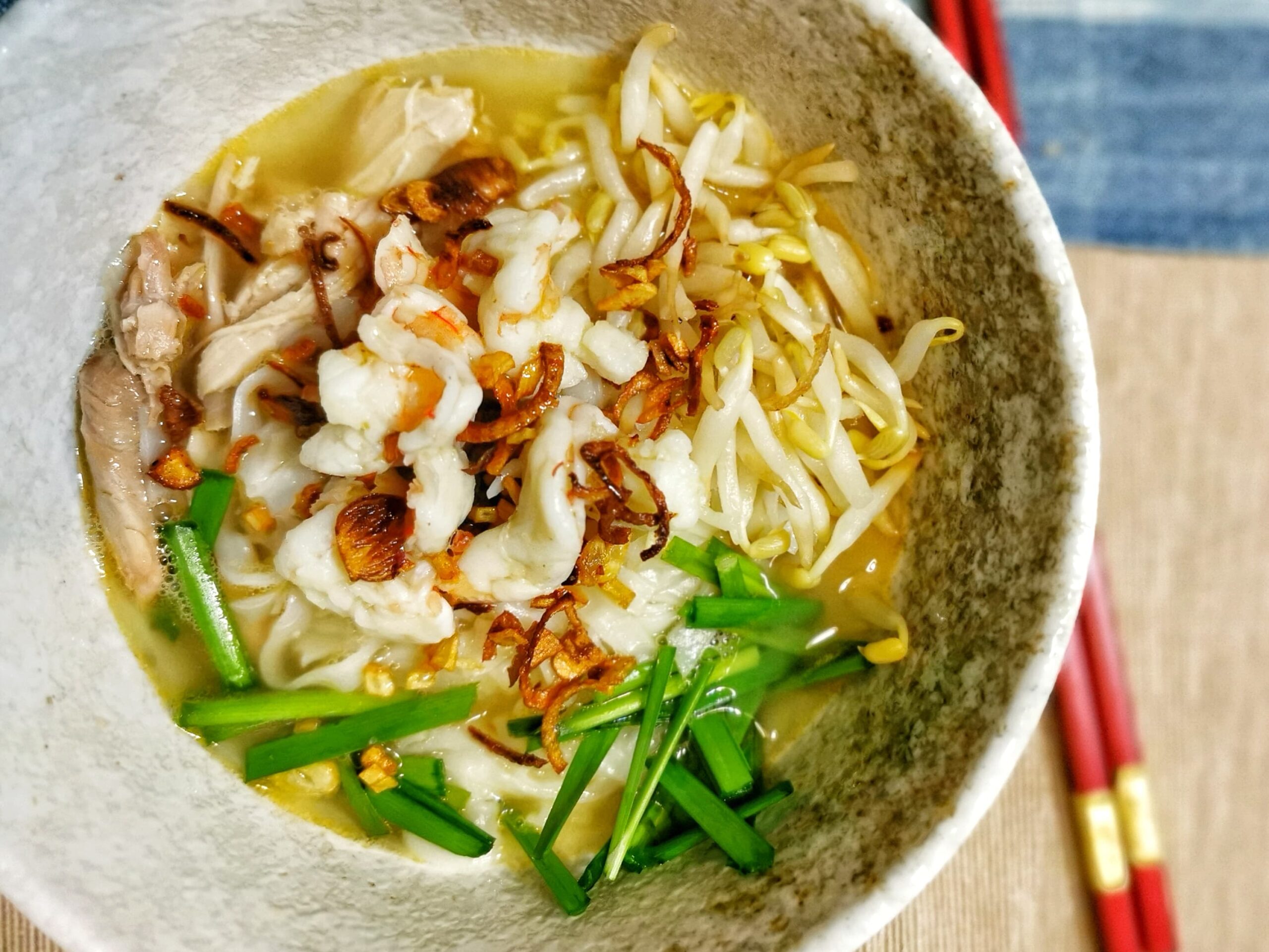
Every Ipohite has their favourite kai si hor fun stall. Mine is Canning Garden’s Little Katong, a relative newcomer compared to the old stalwarts in other parts of Ipoh. I prefer this version because the soup is rich and flavourful without being overly sweet.
For the uninitiated, kai si hor fun stands for shredded chicken rice noodles, a well-loved hawker dish iconic to Ipoh, my hometown. With so many good KSHF stalls around, I never had to worry about cooking it myself. I could stuff myself silly with as many bowls of KSHF as I wanted on my monthly trips to Ipoh.
Curious about the origins of kai si hor fun? Read this fascinating article from Ipoh Echo.
Until, BOOM, COVID19 came along! Deprived of access (because interstate travel is banned for now) the only way to get my KSHF fix is to DIY.
After studying many KSHF recipes, I came to this realization: there is no single definitive kai si hor fun recipe.
There is, however, one common denominator among all the different versions of the dish.
Good kai si hor fun stock must have enough body (i.e. the “thickness” of the soup) and a balanced flavour (i.e. umami and sweetness).
And each chef has his or her own unique way of achieving the best results.
To achieve “body”, I’ve heard that some hawkers use shark bones. I’ve seen recipes that call for carrots and soy beans.
To obtain a rich flavour, I’ve seen cooks use everything everything from prawn heads, chicken bones and dried shrimp to anchovies, rock sugar and fish sauce. Basically, anything that contributes depth of flavour to the soup.

After a lot of to-ing and fro-ing, I finally decided to attempt it myself. Of course I was scared to tackle Ipoh’s most iconic dish! But I told myself, never mind lah, it’s only going into my stomach and hubby’s stomach.
How did it turn out?
We like it 🙂 It’s not as salty or sweet as the commercial KSHF, but that’s fine since hubs and I have a low tolerance for salt and sugar.
Since my maiden attempt, I’ve made KSHF at least half a dozen times. Each time, the ingredients vary slightly because I go with whatever I have in the kitchen. Which could be prawn heads and shells, dried shrimp, chicken stock, fish sauce and sometimes even anchovy and scallop powder! I know, crazy expensive, but hey, this is purely for own consumption. After all, I’ve no plans to open a kai si hor fun stall anytime soon!
Want more Asian-style noodles? Try my mum’s recipe for braised yee mee.

Kai Si Hor Fun

Equipment
- Deep pot, medium-sized pot, strainer
Ingredients
- 300 g Ipoh soup kuay teow
- 8 prawns, deshelled and deveined
- 2 chicken thighs, rubbed with salt
- 4 shallots, sliced
- 4 cloves garlic, diced finely
- 3 tbsp oil
- 1 handful taugeh
- A few stalks chives, cut into segments
Stock
- 5 cups water
- Prawn heads and shells
- Chicken bones
- Thickening and flavour agents - can be dried shrimp, anchovies, chicken stock, anchovy stock, rock sugar, fish sauce, carrots
- salt to taste
Instructions
- Steam the chicken thighs for 20 minutes. Once cooked, the chicken will release tasty juices; keep those juices for your stock. Shred the meat by hand and keep aside.

- Prepare your stock ahead of time. In a big pot, heat up a bit of oil and stir-fry prawn shells and heads until they turn red.
- Add water followed by the chicken juices from Step 1. Add the rest of your flavour and thickening ingredients. Boil for roughly 45 minutes until you can see clearly that the stock has thickened and a thin red flim of prawn oil is clearly visible on the surface. Discard solids and strain stock. You should have roughly 2.5-3 cups stock left.

- Now prepare the rest of your condiments. Heat up a few tbsp oil and fry garlic and shallots. Remove garlic and shallots from the hot oil so they don't burn. Set the oil and aromatics aside for garnishing later.

- Ready to eat? Good, you can start to assemble all the different components. Bring your stock to a boil. Drop raw prawns inside and boil until they're cooked. Set aside.
- Bring a pot of water to a rolling boil. Blanch taugeh for 10 seconds. Remove.
- In the same water, blanch ipoh kuay teow noodles; 5 seconds should be enough as the noodles turn soft very fast! (See Recipe Notes 1)

- Ladle noodles into bowls. Top with cooked prawns, blanched taugeh, shredded chicken meat, fried shallots and garlic, and chopped chives. Pour soup over and spoon a little garlic-shallot oil on top. Add cut chilli if you have any. Serve!
Notes
But if you don’t have any, you can still make delicious broth with chicken bones + dried shrimp + anchovies. 5. How long should I simmer the broth? At least 1.5 to 2 hours for good flavour.
Longer simmer = richer, rounder, more satisfying soup. 6. Why does my broth taste flat or too “thin”? Possible reasons: Not enough bones or prawn heads Too much water Insufficient simmering time Not enough umami elements Soup wasn’t seasoned with a mix of salt + fish sauce + sugar Add dried shrimp, anchovies, or continue simmering to rescue it. 7. How do I get the chicken silky and tender? Poach chicken gently in the broth, then shred while still warm.
Avoid boiling — it toughens the meat. 8. What toppings are essential for kai si hor fun? The classics: Shredded chicken Prawns (optional but lovely) Chives/spring onion A drizzle of prawn oil A sprinkle of white pepper
Optional: fried shallots, but purists keep it simple. 9. Can I make the broth ahead of time? Yes — broth tastes even better the next day.
Store in the fridge for 2–3 days, or freeze for up to 3 months. 10. Why doesn’t my homemade KSHF taste exactly like the Ipoh hawkers’? Because hawkers often use highly concentrated broths, large quantities of prawn heads, rock sugar, MSG and shark bones or specialty ingredients. Don’t worry — a lighter, homemade version is healthier and still wonderfully satisfying.
Alexandra Wong is a Malaysian food writer, recipe developer and the author behind Cook With Ipohbunny. She shares practical family recipes, restaurant recreations and home-cooking tips inspired by Malaysian Chinese cuisine.